See below for a list of the books I suggested.
The aims of this group will be to read and discuss books. Appreciate the importance of ideas and the need for all kinds of them and sharing them. Feeding ideas into community groups and civil society. Promote resilience. Empowering people. Education for human flourishing. Fulfilling people’s need for challenging intellectual engagement as well as social engagement.
For people of any age, ability or background to increase their knowledge by reading and discussing the books. Provide a safe space for sharing information, trying out and challenging opinions, and questioning narratives.
To improve our skills in communicating and evaluating ideas.
To provide and build ideas useful in civil society, volunteer groups, local economy, promote resilience.
To build metaphorical bridges between all people who want communities here in the Highlands to thrive.
To build context for all future conversation by expanding everyone’s inner library of concepts. (A low context discussion is one where every concept that’s mentioned needs to be explained because there’s little knowledge in common. A good example of high context may be found at the end of each chapter of “Thinking, Fast and Slow” where Kahneman imagines office workers at a water cooler referring to the concepts he has just introduced.)
Build resilience against harmful ideas and their influence.
Format
Agree Rules
Because we discuss ideas and arguments, I suggest the following rules for contributors and organisers.
No hate speech. Obviously, no racism, including Antisemitism and Islamophobia. No hate towards political opponents, or based on any physical features, income level, sexuality, etc. No calling for any person(s) to be killed. Respect for democracy and human rights.
Openness. I hope people will wish to attend regularly but this is not a requirement and there is no restriction on who can attend.
Rejection of the “Argument is War” conceptual metaphor. This is of central importance.
We recognise that the weaker argument contributes as well as the stronger. Human cognition is a collaborative process.
Safe space. Respectful disagreement, not reporting outside the group without the contributor’s permission. Respect and encourage changes of opinion. All have different starting points.
No question is stupid. No shaming. Ask if you don’t understand. Everyone making progress from different starting points. Politely correct any unintentional language errors made when referring to ethnic groups etc. By the same token, be uninhibited to introduce any knowledge you think might be helpful.
No top-down management, no hogging the conversation, decisions by consensus.
Accessibility. Providing assistance for anyone too old, young, physically or financially constrained or whatever to attend by themselves.
Inclusive and tolerant of diverse opinions (except hate).
Guidelines for good debate.
Owning your opinion – for example, say “I think x” not “Any reasonable person thinks x”.
Don’t claim that your opinion is common sense, or that there is no alternative to it, or that it is supported by God, by Nature, by human nature, by silent majority, centre ground, etc, etc.
Listen to dissenting voices.
Suggested books which I have read in recent years and think would be interesting to discuss. Most are available as paper, e-book, and audiobook.
I chose books that introduce ideas and concepts or help us to understand and discuss them.
For example, the books about depression, boredom, listening, or drug addiction might add some depth and breadth to any community group involved with the general public, and also add context to thought and discussion when these topics might come up, day to day. There are other books about the quirks of ‘normal’ human psychology.
Books about the challenges that some people in our community are facing, such as disability, racism, poverty, will help build understanding and make connections.
Books about the far right and other forms of Radicalisation, and about how people become drawn down ‘rabbit holes’ and how to counter disinformation may help us to be a positive influence.
Reading a story about a community showing resilience and resourcefulness in the face of a threat can inspire us in creating our own resilience.
Some of the books I have included are about the natural world, plants, animals, ecosystems, and some about the man-made world, economics, design, architecture. Some are more specifically about ideas.
Some are books about historical events or more broadly, historical ideas.
Some books are about thinking, arguing and disagreeing. These, once the group has read them, could be thought of as core texts, and providing further context for future discussion.
List in no particular order:
From What Is to What If, by Rob Hopkins
Thinking Fast and Slow, by Daniel Kahneman
Conflicted, by Ian Leslie
Seeing Like a State, by James C Scott
Escaping the Rabbit Hole, by Mick West
Angrynomics, by Eric Lonergan, Mark Blyth
Doughnut Economics, by Kate Raworth.
The Word for World is Forest, by Ursula K Le Guin (a novel).
On Tyranny by Timothy Snyder
Rule Makers, Rule Breakers by Michele J Gelfand
The Hedgehog and the Fox, by Isiah Berlin
Mindware, by Richard E Nisbett
Poverty Safari, by Darren McGarvey
The Righteous Mind, by Jonathan Haidt
Factfulness, by Hans Rosling
Building Paradise in Hell, by Rebecca Solnit
The Design of Everyday Things, by Don Norman
Essays, by George Orwell
Lost Connections, by Johann Hari
Flat Earth News, by Nick Davies
When Money Dies, by Adam Fergusson
The Bystander Effect, by Catherine Sanderson
The Windrush Betrayal, by Amelia Gentleman
Unspeakable, by Chris Hedges
The Anatomy of Peace, by the Arbinger Institute
How To Listen, by Katie Colombus, The Samaritans
The Good Ancestor, by Roman Krznaric
Becoming Wild, by Carl Safina
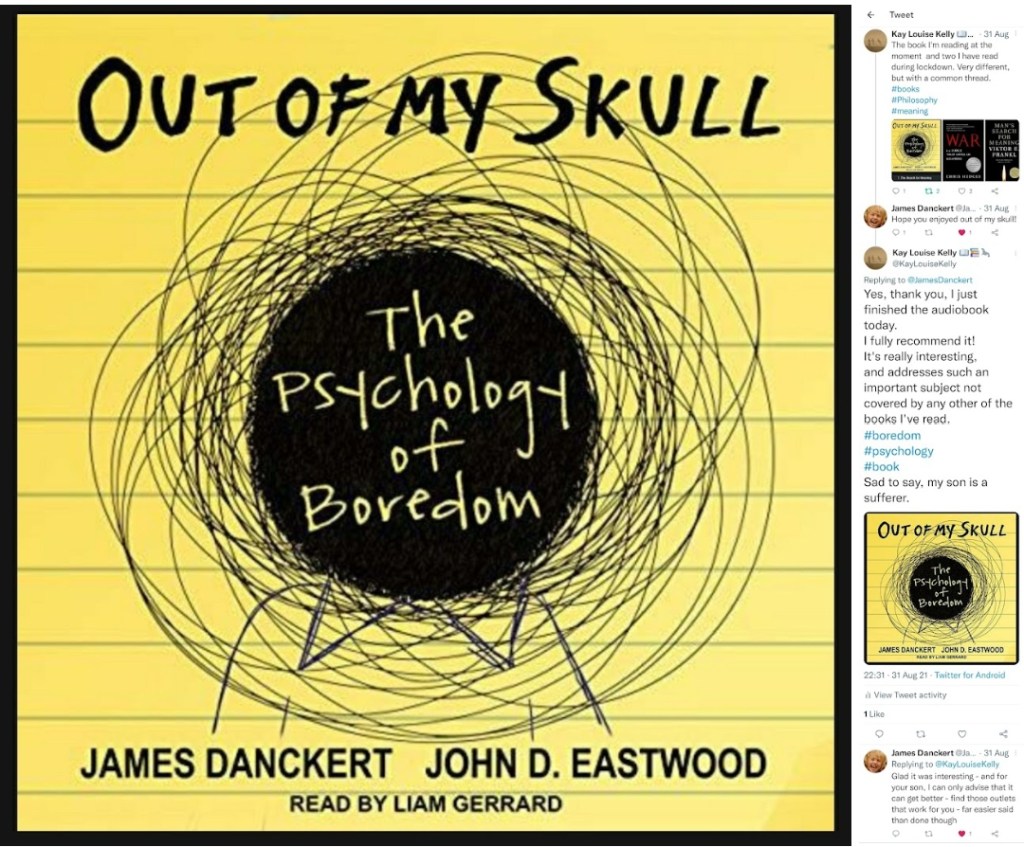
Out of My Skull, by James Dankert, John D Eastwood
Entangled Life, by Merlin Sheldrake
Moral Politics, by George Lakoff
Wilding, by Isabella Tree
Don’t Even Think About It, by George Marshall
The Better Angels of Our Nature, by Steven Pinker
Man’s Search for Meaning, by Victor E Frankl
Hood Feminism, by Mikki Kendall
Crippled, by Frances Ryan
Invisible Women, by Caroline Criado-Perez
Whistling Vivaldi, by Claude M Steele
Strong Men, by Ruth Ben-Ghiat
The Culture Code, by Daniel Coyle.

This is my suggestion for the second book to discuss. It is packed with ideas of proven worth.
It really inspired me to imagine a better future than ecocide and totalitarian rule. I hope it will inspire us all to achieve a more healthful and sustainable world.
 Making Ripples