Did you know that languages changed gradually over time?
Words come and go in popularity, and words enter English from other languages. That’s why, if your story book is 100 years old, for example, you might find some of the words and sentences intriguingly different from what you’re used to.
For example, in books by J K Rowling, Roald Dahl, S F Said, David Walliams, Barbara Henderson, David Almond, Michael Morpurgo etc, you’ll recognise the language as fairly similar to the English you are hearing around you all the time. When you read R L Stevenson, William Cowper, or even J R R Tolkien and Ursula LeGuin, you might find that there are some unusual words there. Perhaps words that you don’t recognise at all, or words that you know, but being used with a slightly different meaning.
When you read writing that is even older, for example, Shakespeare’s plays, you might find this more unfamiliar still.
Anything that is older than Shakespeare’s time, and you might find you need to use a translation, just as you would for a foreign language when you don’t speak it.
Old English was spoken before 1066. From around that time, Middle English was spoken till about 500 years ago, when William Shakespeare wrote in early Modern English. English hasn’t stopped changing.
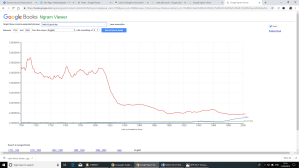
To show how word use changes over time, try the Google ngrams website. Type a word into the search box to see how its frequency has changed over the last 500 years.
To learn about the History of English from the year 410 AD till the present day in about ten minutes, watch this The History of English in Ten Minutes.
Word Roots
When you look up your word, you might find the word roots. They are the ‘ingredients’ that went into the word.
Interestingly, a word root can be shared by more than one word. These words are known as cognates (born together).
Word meanings can slowly change
Word roots don’t necessarily have the same meaning as the word itself, but they usually have a related meaning. It’s the same with cognates, and here’s an example where the cognate words have seemingly opposite meanings: The French word for white is blanc, and it is cognate with the English word blank and black. Similarly, the words fact and fiction share a word root but now have opposite meanings.
A word meaning could also change from literal to metaphorical, a good example is here – one word root meaning fire has come to mean strong feeling, and another has come to mean showy, bold, or conspicuous. One of our fire words came from a root meaning down below; a religious metaphor, perhaps?
Some word roots are so ancient that they can be traced right back to a language that was spoken six thousand years ago! A clue to their age is that they can nowadays be found in several different languages.
The word roots of English words come from Old English, Old Norse (the language of the Vikings) Old French (the language of William the Conqueror) Latin (the language or the ancient Romans and the Roman Catholic church) and Ancient Greek. There are many more, too, with words coming into English from nearly all parts of the Earth.
You might have noticed that the spelling of the word roots can vary. In fact there’s a very interesting way in which words have been seen to change their spellings when they move from one language to another over time, Grimm’s Law.(pdf)
Also, two words (or two word roots) can look the same or similar but have different meanings. A word can have more than one root.
Antonyms are words with opposite meanings. Opposites are a matter of opinion and are there to help you understand a word meaning (- so, what’s cold? it is the opposite of hot).
Cognates are words that share the same origins or word roots.
Etymology means word-origins and word roots.
Homonyms homonym is a word that is said or spelled the same way as another word but has a different meaning. Homophones are words that has the same sound but are spelled differently and has a different meaning
Synonyms are words which have the same or similar meaning.
Word roots are the ‘ingredients’ of a word; they usually come from older words or other languages, and they usually share the word’s meaning, at least in part. They help your knowledge and understanding of words and help you to work out the meaning or spelling of a word that’s new to you.
The Oldest Word Roots. Lists of word roots from the Proto-Indo-European language can be found in Indo-European Cognate Dictionary by Fiona McPherson.
Homophones, homonyms, homographs “Write” and “right” is a good example of a pair of homonyms.
External link on word roots
 Making Ripples